
Description
On the northern coast of South America, several rivers flow into the Atlantic Ocean in an area known as the Guianas – an Amerindian word that likely means 'land of many waters'. One of these is the Suriname River. At the time of the voyages of the Spanish conquistador Alonso de Ojeda the area was inhabited by the Arawaks, Caribs, and Warau. From the late sixteenth century seafarers from England, France, and the Netherlands came to the area in search of El Dorado, the mythical land of gold, which Sir Walter Raleigh believed to be in the Guianas. In 1651 the English governor of Barbados Sir Francis Willoughby founded a plantation colony along the Suriname River. This colony was captured by a Zeeland fleet in 1667 during the Second Anglo-Dutch War.
From 1683 Suriname was administered by the Society of Suriname, a private enterprise with the West India Company, the Van Aerssen van Sommelsdijck family, and the city of Amsterdam as shareholders in equal parts. In 1795 the assets of the Society of Suriname were transferred to the Dutch state, which governed Suriname as a colony until 1954, apart from two periods of British occupation. In that year Suriname, together with the Netherlands and the Netherlands Antilles, accepted the Charter for the Kingdom of the Netherlands, supposedly marking the completion of decolonisation. Suriname gained independence in 1975.
The European private owners put enslaved Amerindian people and Africans to work on their plantations. Some enslaved people managed to escape the plantations and establish free communities in the interior of Suriname. In 1760 the colonial government signed a peace treaty with one of these Maroon groups, the Okanisi (also known as Aukans or Ndyuka). Peace treaties with two other groups, the Saamaka and Matawai, followed in 1762 and 1769, while the Aluku (or Boni), Pamaka, and Kwinti never signed a peace treaty.
From the eighteenth century, missionaries from the Moravian Church were active in Suriname, particularly among the Saamaka. In 1865 Pope Pius IX designated Suriname as a mission territory for Dutch Redemptorists, who were assisted in their work by the Franciscan Sisters of Roosendaal and the Brethren of Tilburg. Amerindian people were converted to Christianity from the former leper colony of Batavia on the Coppename River, while the Tamarin mission station on the Cottica River became the centre of the Catholic mission to the Okanisi.
Collections of Surinamese artifacts in Europe and the United States
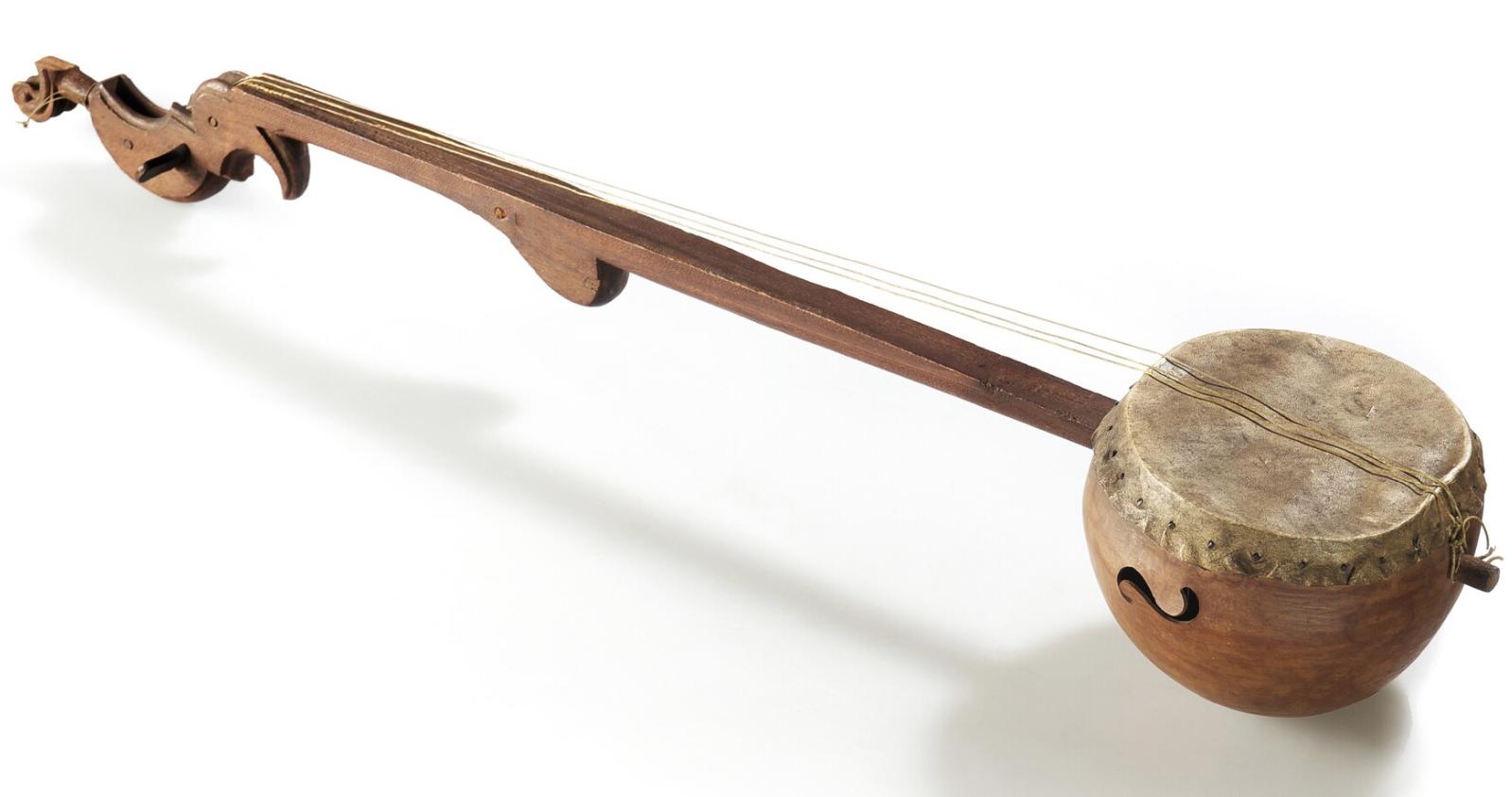 This banjo from the collection of the Royal Cabinet of Curiosities counts as the oldest known banjo from the American continent
Ethnographic objects were brought to Europe from the very beginning of colonisation. A report published in 1796 on expeditions against the Maroons, in which the Scottish-Dutch officer John Gabriel Stedman took part between 1773 and 1777, includes descriptions and illustrations of ethnographic objects. Stedman is known to have made a donation to the stadtholder's collection of William V in 1777 and to have donated eighteen Surinamese 'curiosities' to James Parkinson in 1796 for inclusion in his Leverian collection in London, which was auctioned in 1806. The archives of the Royal Cabinet of Curiosities contain an inventory description taken directly from Stedman's report. Based on this, anthropologists Richard and Sally Price suspect that some of the objects collected by Stedman eventually ended up in the Cabinet. However, in many cases it remains difficult to establish a direct link between Stedman's descriptions and the objects in the collection.
Another important collection from Suriname was donated to the Cabinet in 1824 by Frederik Andreas Kühn, head of the military medical service in Suriname. In his accompanying letter, Kühn wrote that some of the objects had come from his late brother, who had taken part in an expedition to a Maroon community in 1818. It is therefore not always easy to distinguish between Kühn's donation and objects that may have originated from Stedman. Between 1825 and 1835 the Cabinet also received donations from Suriname from individuals including Isaac Bromet, Dietrich Kanngiesser, Hendrik Haagen Dieperink, and Adriaan François Lammens. Lammens, son-in-law and admirer of Gerrit Schouten, was responsible for donating many of Schouten's dioramas to the Cabinet. As a native of Zeeland, he also donated artefacts from Suriname to the Royal Zeeland Scientific Society.
Ethnographic objects from Suriname were also brought to Europe by Protestant and Catholic missionaries. One of the earliest collections was donated in 1780 by missionary Christlieb Quandt to the cabinet of curiosities at the Moravian Seminary in Barby, Germany. In around 1857 the missionary Johann Jansa handed over a collection of objects originating from the area around the Berg en Dal mission station to the archivist of the Moravian Church in Herrnhut. Many of the objects collected by Quandt and Jansa later ended up in the Herrnhut Ethnographic Museum, founded in 1878, although the sale of ethnographic items also served as a source of income for the Moravian Church. For example, in 1861 part of Jansa's collection was sold to the ethnographic cabinet of the Royal Prussian Art Chamber, which was subsumed into the Ethnologisches Museum in Berlin in 1873. A small collection of objects from the Zeist Missionary Society, which is affiliated with the Moravian Church, is on display at Het Herrnhutter Huis Museum in Zeist. A collection belonging to the Redemptorist Fathers is housed at Museon-Omniversum.
The Brethren of Tilburg amassed a large Caribbean Heritage photo collection, which has been made digitally accessible via the website of the Tilburg City Museum. The Utrecht Archives manages the collection of films and audio tapes as well as prints, drawings, maps and photographs of the Zeist Missionary Society.
Other nineteenth-century collections include RV-399 and RV-1054, amassed by Governor Cornelis Ascanius van Sypesteyn and finance administrator Assueer Jacob Schimmelpenninck van der Oye. These were donated to the National Ethnographic Museum, now the Wereldmuseum Leiden, in 1883 and 1895, respectively. The Artis Ethnographic Museum also owned a large Suriname collection, including a rare kwakwabangi, about which curator Cornelis Marinus Pleyte published an article in 1896 in the German journal Globus. In 1921, the Artis collection was transferred to the museum of the Colonial Institute, which opened in 1926 and is now the Wereldmuseum Amsterdam, where it can be identified by the serial letters TM-A.
Explorations along the rivers
 Dance crown originating from Trio Amerindians, collected during the Tumuk Humak expedition of 1907
Gold discoveries in the Marowijne River basin basin led to increased international interest in Suriname from the late 1870s. In 1877 French physician Jules Crevaux, accompanied by the Aluku guide and boatman Apatou, travelled via the upper reaches of the Marowijne to Belém in Brazil. Crevaux donated the objects he collected during his travels to the Musée du Trocadéro in Paris, one of the precursors of the current Musée du Quai Branly – Jacques Chirac. The same applied to objects collected by Lucien Fournereau along the Marowijne River in 1882. Objects from Suriname exhibited at the 1878 World’s Fair in Paris and the 1883 World’s Fair in Amsterdam were distributed among various ethnographic museums after the exhibitions; in the Netherlands this resulted in the series RV-300 and RV-370.
Herman ten Kate stayed in Suriname from May 1885 to July 1886 to compile RV-581 for the National Ethnographic Museum. During the same period, Leiden professor of geology Karl Martin collected specimens from Amerindians and the Saamaka; in 1949 the collection was donated by his widow Hillegonda Martin-Icke and incorporated into the museum as series RV-2777. In 1887 Apatou guided another Frenchman, the geographer and colonial official Henri Coudreau, along the upper reaches of the Marowijne. His collection was also housed at the Musée du Trocadéro. In 1888 Army Surgeon John H. Spitzly donated a collection of ethnographic objects from Suriname to the Berliner Gesellschaft für Anthropologie, Ethnologie und Urgeschichte.
The 1890 research expeditions by the German Wilhelm Joest and the Swede Axel Klinckowström resulted in donations to the Ethnologisches Museum in Berlin and the Etnografiska museet in Stockholm, respectively. After his death, Joest’s private collection, which included many objects from Suriname, formed the basis for the Rautenstrauch-Joest-Museum in Cologne.
For the ethnographic collections in the Netherlands, the exhibition on the Dutch West Indies held in 1899 at the Colonial Museum in Haarlem was particularly significant. The exhibition featured objects collected, mainly from Okanisi, by colonial official Louis Constant van Panhuys during his posting in Albina between 1893 and 1896. The modest collection of ethnographic objects that Gaspard van Breugel had assembled in 1823 at the Clifford Kocqshoven plantation was also exhibited at that time. These collections are now part of the TM-H series at the Wereldmuseum Amsterdam.
In 1901 Maurice Guffroy, director of the Compagnie des mines d'or de la Guyane hollandaise, donated a large collection of Wayana and Aluku artifacts to the Musée du Trocadéro. Three of the eight expeditions to Suriname organised shortly after the turn of the century under the auspices of the Royal Dutch Geographical Society (KNAG) yielded extensive ethnographic collections, which are now part of the collection of the Wereldmuseum Amsterdam. The 1903 expedition to the Gonini River resulted in series TM-401 with 86 objects, the 1904 expedition to the Tapanahony River yielded series TM-402 comprising 493 objects and the 1907 expedition to the Tumuk Humak Mountains yielded series TM-403 with 186 objects. A jewellery box referencing the Gonini expedition is part of the collection of the Rijksmuseum Amsterdam. In 1904 expedition member Claudius de Goeje donated a personal collection to the museum in Leiden, where it was catalogued under serial numbers RV-1443 and RV-1454.
Collections RV-1817 and RV-2349, which were gathered from Caribs by the Surinamese brothers Frederik Paul and Arthur Philip Penard, were donated to the museum in Leiden in 1912 and 1937, respectively. Finally, the 1926 KNAG expedition to the Wilhelmina Mountains led by Gerold Stahel yielded the series TM-416 held in the museum in Amsterdam.
The Museum for Education in The Hague, now the Museon-Omniversum, opened an exhibition on Suriname in late 1923. The exhibition was based on objects collected Herman van Cappelle, the museum's first director, during his stay in Suriname. These included a second kwakwabangi, which is still part of the Museon-Omniversum collection. The Tropisch Landbouwmuseum, which opened in 1915, also had a small Suriname collection.
Scientific research during the interwar period
The interwar period saw steady growth in scientific interest in Maroons and Amerindian societies. American anthropologists Melville J. and Frances Herskovits visited the Saamaka on the upper reaches of the Suriname River in 1928 and 1929. Approximately two hundred of the objects they collected were donated in 1929 to the Museum für Völkerkunde Hamburg, now the Museum am Rothenbaum – Kulturen und Künste der Welt (MARKK), where the collection was catalogued under serial number 30.51. The private collection they assembled during their visits is now housed at the Schomburg Center for Research in Black Culture in New York. The photographs are held in the Eliot Elisofon Photographic Archives, National Museum of African Art.
In 1927, 1928, and 1930 American physician Morton Kahn collected artifacts in Suriname for the American Museum of Natural History. In 1931, French industrialists Marcel Monteux and Marc Richard financed a multidisciplinary research mission to French Guiana, which yielded a collection of artifacts that was donated to the Musée du Trocadéro. In 1934 a large collection of objects was gathered along the Marowijne River for the Musée du Trocadéro by Leon-Gontran Damas, a student at the Institute of Ethnology in Paris. The following year Damas was to lay the groundwork for the Négritude movement alongside Aimé Césaire and Léopold Senghor. In 1937 Claudius de Goeje was attached as an unpaid ethnographer and linguist to the third expedition to Suriname's southern border led by Conrad Carel Käyser. The collection he amassed during this expedition at the expense of the Dutch government was donated to the Rijks Etnografisch Museum in 1938 and 1939 and is still housed at the Wereldmuseum Leiden under serial numbers RV-2352, RV-2363 and RV-2404. The French ethnologist Paul Sangnier also collected objects from the Wayana and Aluku in 1938.
A 1940 bequest from landscape architect Apollonius Johannes Reynvaan, who assembled an extensive collection of 850 objects from Suriname, is of great significance for the collections in the Netherlands. Reynvaan's collection is housed at the Wereldmuseum in Leiden under accession number RV-2452.
The 1946 expedition to the Marowijne River basin by the French geographer Jean-Marcel Hurault in a sense marks a turning point in the history of collecting in Suriname and French Guiana. Although the distinction is not always clear-cut collections gathered after this point – not coincidentally the year that French Guiana became an overseas department of France – less explicitly reflect being the result of colonial exploration. After Hurault's death in 2005 the objects he collected along the Marowijne River were transferred to the Musée du Quai Branly – Jacques Chirac.
With regard to the collections in the Netherlands, the objects collected by C. D. H. Eijgenberger from the late 1940s and the gifts presented to Queen Juliana during her 1955 visit to autonomous Suriname fall into this borderline category. Eijgenberger's collection, which includes rare slave shackles, was acquired by the Wereldmuseum Amsterdam in 1978 and was assigned serial number TM-4440. The gifts to Queen Juliana were housed at the Museon-Omniversum in 1957.
Other collections established after 1954 fall outside the scope of this research aid as they lack an explicit colonial context.
Provenance research
To research donations to the various museums, first follow the recommendations in the research aids of the respective museums. When investigating the distribution of cultural artifacts from specific groups across museums in the Global North, it is advisable to broaden the scope beyond to the Netherlands. Networks in countries of origin can be particularly useful in this regard. For example, a Wayana group in French Guiana has set up the internet portal watau.fr with the aim of mapping Wayana heritage scattered across the globe.
Museums in countries of origin also have significant expertise in this area. The Museu Paraense Emilio Goeldi in Belém (Brazil), the Musée des cultures Guyanaises in Cayenne (French Guiana), and the Suriname Museum Foundation in Paramaribo have joined forces to form the Amazonian Museum Network. For research on cultural objects of the Saamaka and Okanisi, please contact the Saamaka Museum and the Diitabiki Museum Fositen Gudu, respectively.
Sources
Secondary sources
Related research aids
Keywords
Click on the button behind the keyword to start a new object search.